
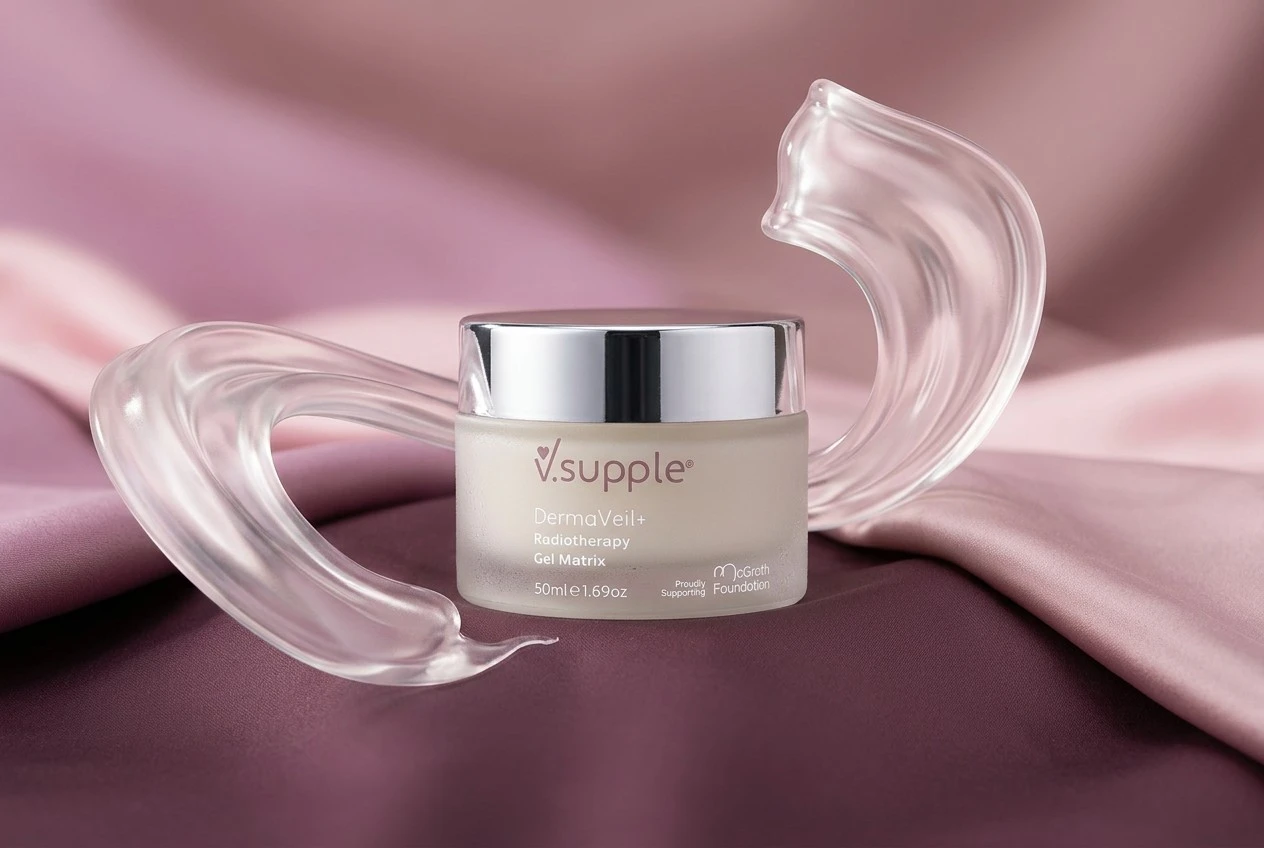
Silicone Isn’t the Villain. It’s the Veil Stressed Skin Needs
Silicone has become one of those skincare ingredients people love to question. It gets called heavy, unnecessary, or something that “just sits on the skin”. But when skin is dry, fragile, irritated, or rubbing against clothing every day, sitting on the skin can actually be the point. In the case of V.supple® DermaVeil+, silicone is not there by accident. It is there because stressed skin often needs a protective veil, not just another moisturiser.
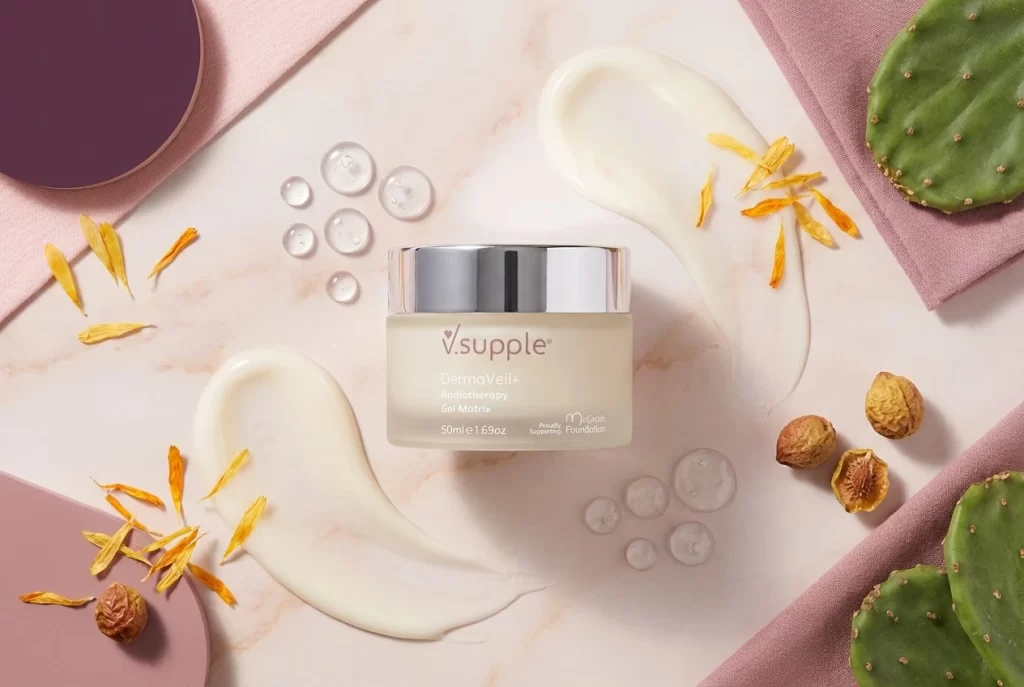
DermaVeil+ was developed as a radiotherapy gel matrix designed to hydrate, calm and protect sensitive or post-treatment skin. Internally, the formula story is built around a silicone-rich gel base, an eleven-type hyaluronic acid complex, a ceramide-lipid barrier blend, soothing calendula and bisabolol, and antioxidant support from vitamin E, Kakadu plum and prickly pear seed oils. In customer language, that means comfort, hydration, and barrier support all working together.
What is silicone actually doing here?
In a formula like DermaVeil+, silicone helps create a light, semi-occlusive layer over the skin. That layer helps slow down water loss from the surface and gives stressed skin a more protected environment. Our clinical summary paper, a review of all the science backing the formulation, describes the silicone gel matrix as forming a flexible film that reduces water loss, helps protect against friction from clothing or dressings, and supports a more stable environment for skin recovery and scar maturation once the skin has closed.
That idea is consistent with dermatology guidance and scar-care research. The American Academy of Dermatology notes that silicone gels and sheets are used to help prevent and improve raised scars after the wound has closed, and a systematic review and meta-analysis found topical silicone gel improved scar pigmentation, height and pliability after surgery. Reviews also describe silicone as a semi-occlusive, hydrating barrier that helps normalise collagen behaviour in healing skin.
So the real answer is simple: silicone is used because it helps skin hold onto hydration and feel less exposed.
Why that matters in post-treatment skin
Post-treatment skin is often not dealing with one problem. It can feel dry, tight, sensitive, warm, rubbed, and more reactive than usual at the same time. That is why “just use a moisturiser” is not always the full answer. DermaVeil+ was clearly designed around the idea that stressed skin needs several forms of support at once: hydration, barrier reinforcement, soothing ingredients, and a surface layer that helps all of that stay where it is needed.
Public evidence helps explain why film-forming protection matters in radiotherapy settings. A 2023 meta-analysis in breast cancer care found barrier films improved both clinician-reported and patient-reported outcomes, including lower rates of more severe radiation dermatitis and moist desquamation. A broader 2023 systematic review and meta-analysis also found barrier films and dressings were associated with reduced acute radiation dermatitis. That does not prove every silicone-based product will perform the same way, but it does support the value of a protective film approach when skin is under treatment stress.
This is where the word “veil” really makes sense. It is not about sealing skin off. It is about helping skin feel less exposed while it is trying to cope.
Why DermaVeil+ is more than just silicone
This is the most important part for customers to understand. Silicone is useful, but silicone alone is not the whole formula story.
DermaVeil+ also includes a multi-layer hyaluronic acid complex. Dermaveil+ uses multiple forms of hyaluronic acid with different molecular weights, so some sit closer to the surface while others support hydration deeper within the upper layers of skin. Our clinical paper describes support for the skin’s own hyaluronic acid production, which is why the formula is positioned as more than a quick surface fix.
Dermaveil+ simplifies this beautifully into “deep, multi-layer hydration”, and that is exactly how it should be provided to customers. Skin that feels parched does not just need something slippery on top. It needs a formula that helps replenish water in more than one way.
Then there is the barrier blend. DermaVeil+ uses ceramides, cholesterol and phytosphingosine, which are all ingredients associated with skin barrier support. Our clinical summary paper explains that this lipid system is intended to help rebuild the structure of stressed skin and reduce dryness and sensitivity. In simple terms, these ingredients help skin feel less fragile.
On top of that, DermaVeil+ includes calendula and bisabolol for soothing support, plus antioxidant-rich oils such as Kakadu plum and prickly pear seed oil. The internal rationale is that these ingredients help support skin facing inflammation and oxidative stress. That matters because post-treatment skin is not only dry. It is often irritated and overwhelmed as well.
But is silicone perfect?
It is better to be honest here. Silicone is useful, but it is not magic, and not every silicone product is the same.
Some research suggests that certain moisturiser-based scar products can outperform some fluid silicone gels in short-term hydration testing. Other reviews note that while silicone gels are widely used and often helpful, study quality is mixed and results can vary depending on the exact formula. That is a good reminder that the whole product matters, not just one trending ingredient label.
That makes the DermaVeil+ story stronger. The value is not “silicone full stop”. The value is a silicone gel matrix combined with multi-level hydration, barrier lipids, soothing actives, and antioxidant oils. In other words, the veil matters, but what sits beneath the veil matters too.
So why do we use silicone in V.supple® DermaVeil+?
Because sometimes comfort starts with protection.
Silicone helps DermaVeil+ create a breathable, light protective layer that supports hydration and reduces surface stress. It can help skin feel less dry, less rubbed, and less exposed. Public scar-care guidance and reviews support its long-standing place in topical scar management, especially once skin has healed over. In radiotherapy-related skin care, the broader evidence around barrier films helps explain why this kind of protective approach is still so relevant.
What makes DermaVeil+ different is that it does not stop there. It pairs that protective veil with hyaluronic acid, ceramides, cholesterol, phytosphingosine, calendula, bisabolol, vitamin E, Kakadu plum and prickly pear seed oils to support hydration, calm and recovery from multiple angles. That is why silicone belongs in the formula. Not because it is fashionable, but because it has a job to do.
As always, silicone-based scar-style products are generally used on intact or healed skin rather than open, heavily weeping, or infected areas, and people having radiotherapy should still follow the guidance of their treating team about timing and application.
Sometimes the ingredient that gets misunderstood most is the one quietly doing the practical work. For skin that feels vulnerable, a gentle veil can be exactly what relief looks like.