
The Midlife Collision: What Australian Women Need to Know About Perimenopause and Postmenopause
Australia has officially entered its menopause era.
There are Senate inquiries, media campaigns, sold-out conferences, social feeds full of advice, and major government changes now moving through Medicare, the PBS and clinician education. Australia’s first national clinical guidelines for perimenopause and menopause are in development, a national awareness campaign is on the way, and the government says dedicated menopause support is being built into health assessments, clinics and treatment access.
On one level, this is brilliant. Silence has not served women well.
Recent Australian research found that women saw the growing public attention on menopause as important for breaking stigma, shame and intergenerational silence. But the same research also found concern that commercial interests were shaping the menopause conversation for profit, and that women wanted more credible, accessible information from governments, health professionals and trusted services.
That tension is exactly where many women are living right now.
Because while menopause is finally being discussed out loud, many women still feel deeply alone in it. They are trying to decode whether the anxiety, exhaustion, rage, poor sleep, heavier periods, hot flushes, dry skin, painful sex, loss of confidence, or strange sense of not feeling like themselves is “just stress”, “just ageing”, “just life”, or something hormonal. And too often, they are having to figure that out in the middle of work pressure, ageing parents, teenagers, money worries, and relationships that need more from them than they have left to give.
That is not just menopause. That is what Australian researchers have called the midlife collision. In a 2025 qualitative study of Australian women, researchers found that menopause often sits alongside intergenerational caregiving, workplace stress, financial strain, relationship challenges and health concerns, and that for many women menopause makes already difficult midlife stressors harder to carry.
That is why this conversation needs to get smarter.
Not louder. Smarter.
First, let’s say the thing many women need to hear
If you are in your forties, your periods are still turning up, and you still feel wildly different, that does not mean you are imagining it.
Healthdirect describes perimenopause as the stage leading up to your last period. Periods may become irregular, and symptoms can include hot flushes and vaginal dryness. Tests usually are not needed to check if you are in perimenopause. Jean Hailes similarly says the most reliable sign is a change in menstrual pattern, and that home blood or saliva tests marketed to diagnose or predict menopause are not recommended.
The Royal Women’s Hospital says menopause usually happens gradually, with the transition running from the start of menstrual changes until one year after the final menstrual period. Symptoms often begin around age 47, peak around the final period, and for some women can continue for more than ten years.
That matters, because one of the biggest reasons women feel dismissed is that they have been taught to look for one neat menopause storyline. One birthday. One blood test. One dramatic hot flush. One final period. One answer.
Real life is messier.
And current Australian evidence is pushing that conversation forward. Reporting on the large Australian Women’s Midlife Years study noted that moderate to severe hot flushes and night sweats were a defining symptom of late perimenopause, and that relying only on menstrual irregularity may miss women who are symptomatic but still cycling.
So no, you do not need to be “fully menopausal” to deserve proper care.
Second, not everything happening at 45 to 55 is hormones
This is where the online conversation often gets lazy.
Jean Hailes is very clear that not all health issues and concerns in midlife are due directly to menopause. Midlife is also a time when work, finances, relationships, general health, and life pressure can shape how symptoms are experienced.
That does not make symptoms less real. It makes the picture more complete.
The problem with some online menopause content is not that it validates women. Validation is needed. The problem is that it can flatten every problem into a hormone story, then sell the fix. The Royal Women’s Hospital has warned that women are being flooded with products, advice and social media claims that are not always evidence-based, and ABC reporting on the Australian Senate inquiry described social media as a space where unsubstantiated product claims are being pushed at women already looking for answers.
In February 2025, even a Sydney menopause conference became a national flashpoint, with debate over hormone doses, testosterone claims, social media influence and the tension between patient demand and evidence-based medicine.
So the real question is not “Should women talk about menopause?”
Absolutely yes.
The real question is, “Who is helping women understand it responsibly?”
What is actually common, and what deserves more attention?
RANZCOG says most women, around 80%, experience symptoms at menopause, most commonly hot flushes, night sweats and vaginal dryness, while around 25% have severe and/or prolonged symptoms that may require medical intervention. Jean Hailes similarly says around one in four women will have severe menopausal symptoms that interrupt daily life and quality of life.
That alone should end the old cultural script that menopause is just a private inconvenience women should quietly “push through”.
But there is another problem too. Some symptoms get all the headlines, and some are barely spoken about.
Hot flushes get airtime.
Mood changes get airtime.
Brain fog is finally getting airtime.
But dryness, vulval irritation, painful intimacy, stinging, chafing and the loss of everyday comfort are still too often whispered about, minimised, or folded into the vague category of “women’s issues”.
That silence costs women.
Healthdirect says vaginal dryness is especially common after menopause, affecting more than 1 in 2 females after menopause, and that it can cause burning, itching and pain during sex. Jean Hailes also notes that around the time of menopause women may experience vaginal dryness, reduced elasticity, painful sex, and vulval irritation including burning, itching, redness and swelling.
This is exactly the kind of symptom burden that can make a woman feel unlike herself in a very private, everyday way. Not dramatic enough to explain to everyone. Not always visible. But absolutely capable of reshaping confidence, intimacy, exercise, clothing choices, sleep, and how she moves through her day.
What evidence-based help actually looks like
This is where women deserve better than slogans.
Good menopause care is not one-size-fits-all, but the evidence-based frame is much clearer than social media sometimes suggests.
Jean Hailes states that menopausal hormone therapy, or MHT, is the most effective treatment for hot flushes, night sweats and vaginal dryness when it is appropriate for the individual. RANZCOG says women approaching menopause should be offered information, advice, and individualised discussion of management options, along with broader routine health assessment and prevention around cardiovascular, bone and mental health.
Australia is also beginning to move the system itself. The federal government says the first PBS listing of new menopausal hormone therapies in over 20 years has already helped hundreds of thousands of women save money, while new menopause and perimenopause health assessment items were introduced from 1 July 2025 and national clinical guidelines are being developed. NSW is also building statewide menopause services and clinician resources for severe or complex symptoms.
That is the macro story.
The personal story is simpler.
Women need care that listens before it prescribes.
Care that explains before it sells.
Care that acknowledges both biology and context.
Care that says, “Yes, this can be menopause”, without saying, “Everything is menopause”.
And care that does not force women to choose between silence and hype.
The symptom nobody wants to google, but nearly everyone should talk about
Let’s talk about the quiet one.
Not just vaginal dryness.
Not just painful sex.
Not just irritation.
But the broader sense that the vulval area suddenly feels more fragile, more reactive, more dry, more easily irritated, and less forgiving than it used to.
That experience is deeply common, and deeply under-discussed.
Some women notice it with sex. Some notice it when they exercise. Some notice it getting dressed, walking, sleeping, after showering, or after using products that never used to bother them. Some simply notice that the tissues feel less comfortable, less resilient, and less like their own.
For some women, prescription or pharmacy options may be part of the answer. Healthdirect notes that lubricants and vaginal moisturisers can help ease symptoms of a dry vagina and do not require a prescription, while Jean Hailes advises women to talk with a doctor if symptoms are affecting daily life or relationships.
But there is also a very practical external comfort conversation that deserves space, especially for women who are dealing with dryness, irritation and discomfort of the external vulval area.
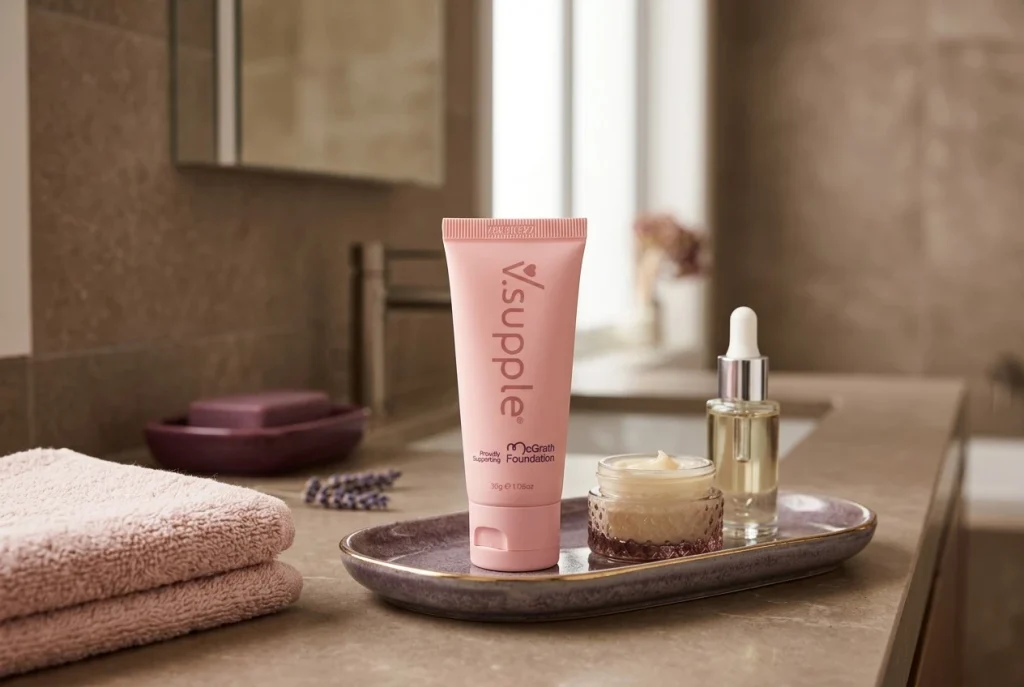
That is where a product like V.supple® Balm belongs in this discussion.
Not as menopause theatre.
Not as a miracle.
Not as a replacement for proper medical assessment when needed.
Just as a credible, useful, on-brand support product.
V.supple® Balm is a hormone-free, fragrance-free topical moisturising cream designed to relieve dryness, irritation and discomfort in the external vulval area. It is positioned for women navigating menopause, post-partum recovery, low oestrogen states, or general sensitivity, and uses microsphere hyaluronic acid, natural vitamin E, avocado oil, glycerin and an emollient base to support hydration and comfort.
That positioning works because it is specific.
It does not claim to fix hot flushes.
It does not pretend to solve the whole menopause transition.
It does not try to hijack the broader medical conversation.
It simply addresses one of the most quietly disruptive symptoms in a way many women will instantly recognise.
And in a sea of menopause noise, that kind of specificity is powerful.
So what should women take from all this?
That they are not behind.
Not weak.
Not vain.
Not hysterical.
Not “just stressed”.
Not too young to ask better questions.
And not required to become their own specialist just to get through a normal life stage.
Australia is changing. The policy shift is real. The public conversation is real. The demand for better care is real. But the best menopause content will not be the loudest. It will be the content that helps women feel clearer, less ashamed, and less alone.
That is the standard worth aiming for.
Because for many women, the most powerful menopause message is not “buy this”, “biohack this”, or “fix yourself”.
It is this:
You are allowed to understand what is happening to you. You are allowed to ask for help earlier. And you are allowed to want comfort, clarity and dignity at every stage of the transition.